
Carbon foil repair: scratches, chips and cracks explained
Every foil picks up damage sooner or later. Most of it is small. Scratches are the most common kind, and the easiest to deal with. Some damage, though, is a safety issue. Here is how to tell the difference, and what a repair actually involves.
Scratches and scuffs
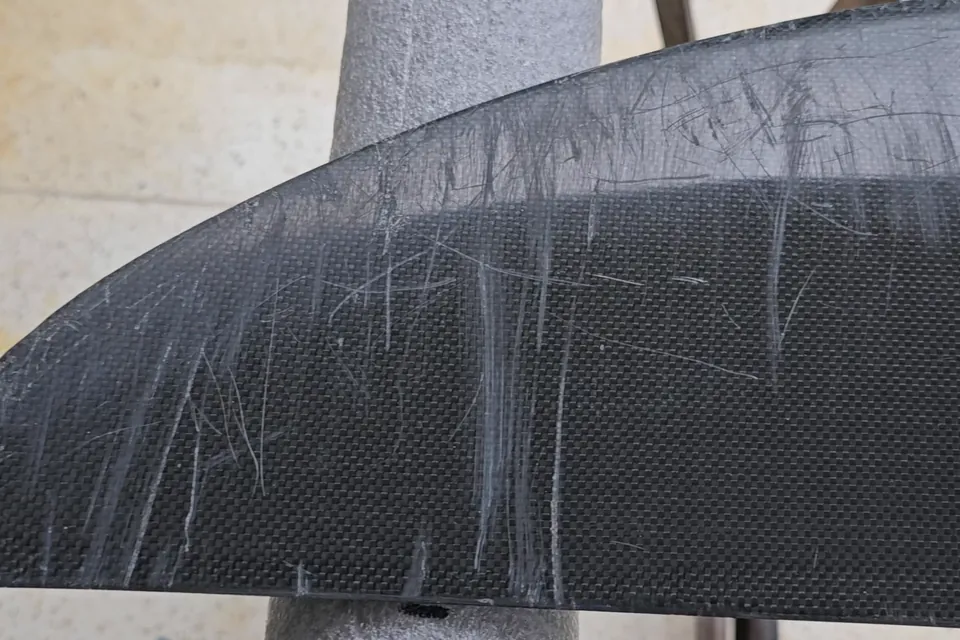
Light scratches and white marks are usually cosmetic. Most of the time, they do not change how the foil rides.
The surface still matters, though. Water flowing over a foil is sensitive to roughness. Scratches slow you down a little, and you feel it more the faster you go. A smooth surface also helps cut turbulence and ventilation.
A simple test: run your fingernail across the scratch. If your nail catches, the groove is deep. It needs to be filled, not just sanded.
Chips and dings on tips and edges
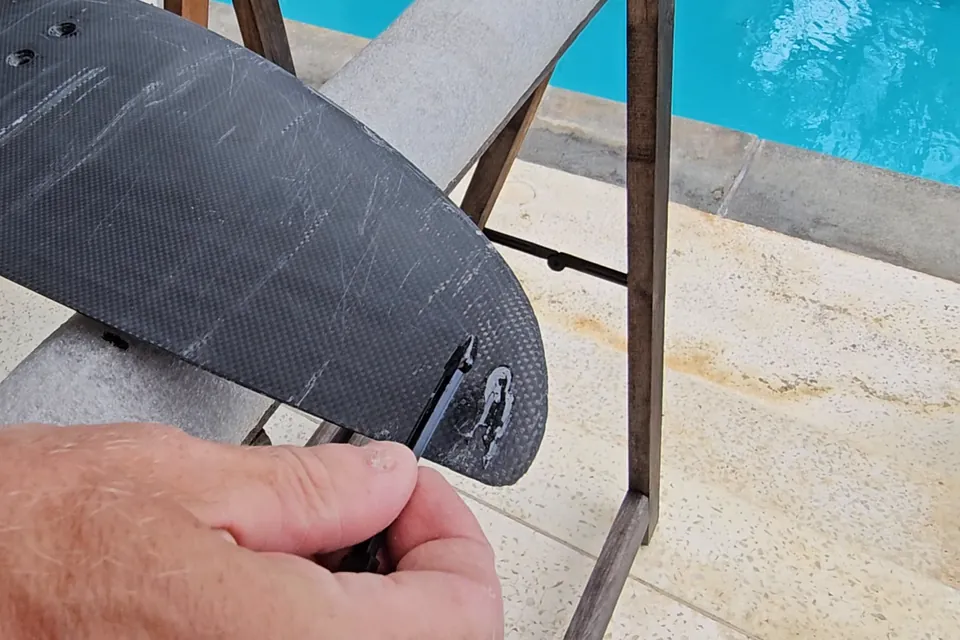
Chips often happen on land. A gust tips the board over, or the foil falls onto a wing tip. They also happen when you ride too shallow and touch the bottom.
Carbon is sensitive to knocks, especially at the tips and trailing edges. A chip there hurts performance, and an open carbon edge can cut you.
The good news: a chipped tip can often be rebuilt. With the right tools and experience, a repairer can bring it close to its original shape. This is careful work. Small mistakes at the tip can upset the balance of the wing, so it is not a good first DIY job.
Cracks
Cracks are a different story. Unlike a scratch, a crack usually points to a structural problem. Do not ride a cracked part.
Cracks in front wings and stabilizers can often be repaired by specialists. But every case is different, and a crack can run further than you can see. In composites, damage around an impact can reach past the visible mark.
Our work is surface repair: scratches, scuffs, and chipped tips and edges. If you find a crack, send photos first. We will tell you honestly whether it can be repaired or whether the part should be replaced.
Why a cracked mast is usually replaced
The mast takes the most load in the whole foil. Riding with a cracked mast puts the whole setup at risk, and you with it. For a mast, replacement is the safest choice.
Brand manuals say the same in plain words. Never use damaged or broken parts. If a part shows damage, stop riding it until it is repaired or replaced.
What a hand repair involves
Here is what a cosmetic repair of scratches or a chipped tip looks like:
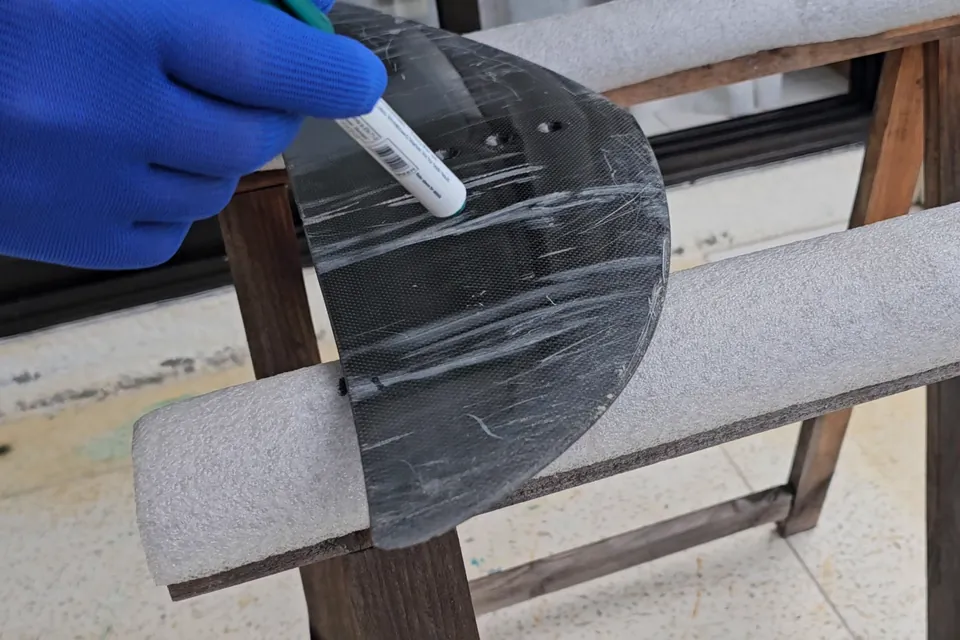
- Inspect and mark. We check the whole part, not just the obvious mark, and make sure it really is a surface job.
- Sand out the damage. We work by hand and go slowly. Power tools can seriously damage carbon. It is easy to remove material and hard to put it back.
- Clean. The area is degreased and dried. Repair materials bond best to a surface that is clean, dry and sanded.
- Fill. Deep scratches and chips are filled, and the fill is left to cure fully.
- Level. We sand the fill flush with a block, following the original shape. The goal is to restore the surface, not to reshape the profile.
- Finish coat. A finish coat goes on last.
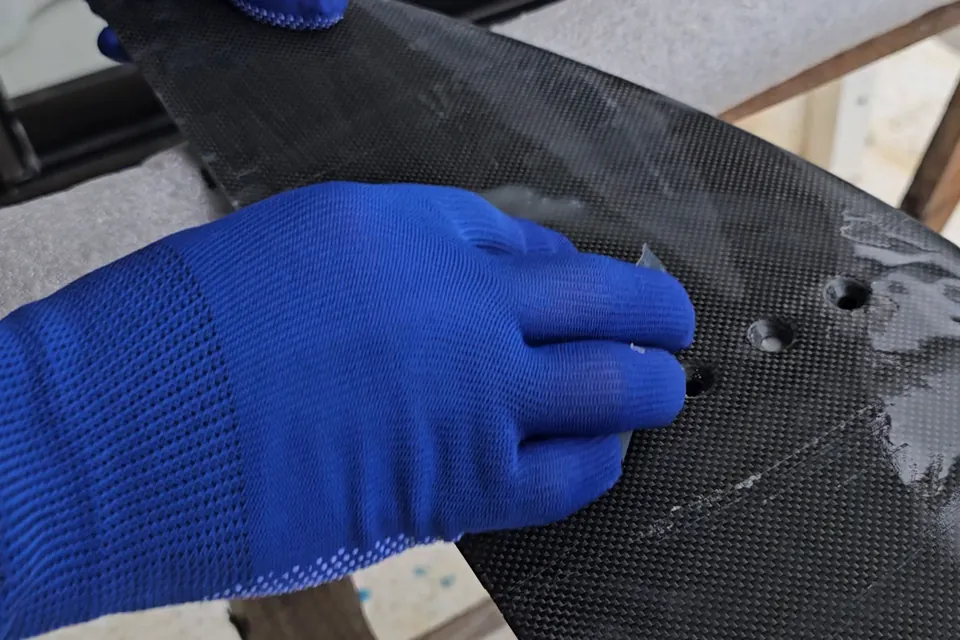
A cosmetic repair brings back a smooth, even surface. It does not fix hidden structural damage. That is why the inspection comes first.
Check your warranty first
Before any repair, think about your warranty. Some brands treat sanding, filling or other changes as a modification:
- F-ONE's carbon mast manual says the profile shape must not be modified, filled or sanded. Its warranty does not cover damage caused by any alteration of the original equipment.
- Sabfoil's warranty excludes modification of any part, and damage from attempted repair.
- Armstrong's warranty excludes unauthorized repair.
At the same time, many warranties do not cover impact damage, such as hitting the seabed, a reef or a rock. So a chip from a knock is often not a warranty case anyway. But a repair could get in the way of a later claim for something else.
If your foil is still under warranty, contact the brand or your dealer first. Take clear, dated photos of the damage before anything is touched. Brands often ask for them with a claim.
Send us two photos
Send us a close-up of the damage and one photo of the whole part, plus the brand and model. We will tell you honestly what we see and what we would do.
Sources
- ENSIS – How to Repair and Maintain Your Hydro Foil
- SROKA – How to maintain your carbon foil?
- F-ONE – Hydrofoil Carbon Mast user guide (PDF)
- GONG – Allvator carbon foil user guide (PDF)
- WEST SYSTEM – Fiberglass Boat Repair & Maintenance (PDF)
- WEST SYSTEM – Surface Preparation
- Windance – Wing Foil Maintenance & Corrosion Prevention
- Sabfoil – Warning & Safety
- Sabfoil – Surf manual rev01 (PDF)
- Cabrinha – Fusion Foil user manual (PDF)
- Armstrong Foils – Warranty and Replacement Policy