
How to check your foil for damage after a session
Foils take knocks. You ride a bit too shallow, a gust tips the board over on the beach, or a wing tip lands in the sand. Over time, some damage is almost certain. The good news: a quick check after each session catches most problems while they are still small.
Foil brands agree on this. Most manuals ask you to check your foil, and the screws, every time you ride.
Get ready
- Rinse and take it apart. Rinse every part with fresh water. Separate the wings, fuselage and mast.
- Wipe it dry with a soft cloth. Your hand is a good tool. Wiping each part lets you feel bumps, nicks and rough spots your eyes can miss.
- Find good light. Bright shade works well. Tilt each part so the light runs across the surface.
The checklist
Front wing and stabilizer
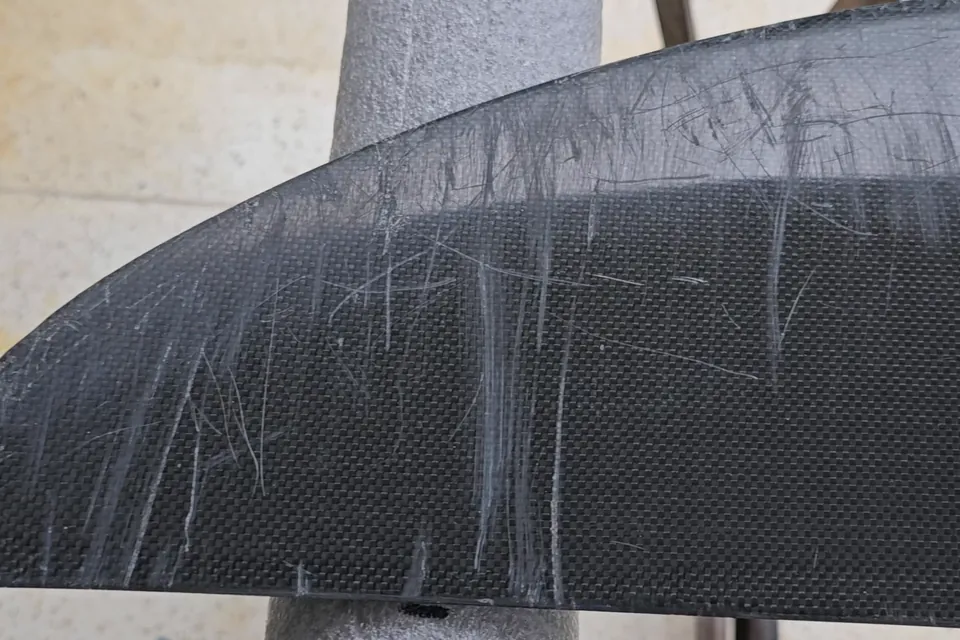
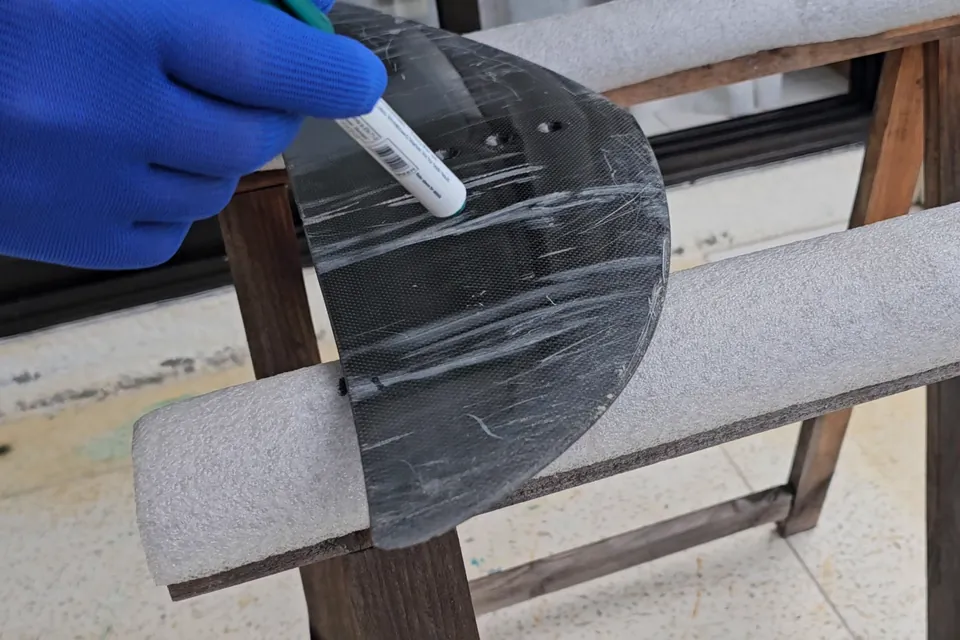
- Look over both sides for scratches, scuffs and white marks.
- Run a fingernail across any scratch. If your nail catches, the scratch is deep.
- Look for cracks, including around the screw holes.
- Press gently around any impact mark. A spot that feels soft, or a skin that moves, is a warning sign.
- Tap lightly around the area with a coin. Solid carbon sounds clear. A dull or flat sound can mean a gap under the surface.
Leading edge, trailing edge and tips
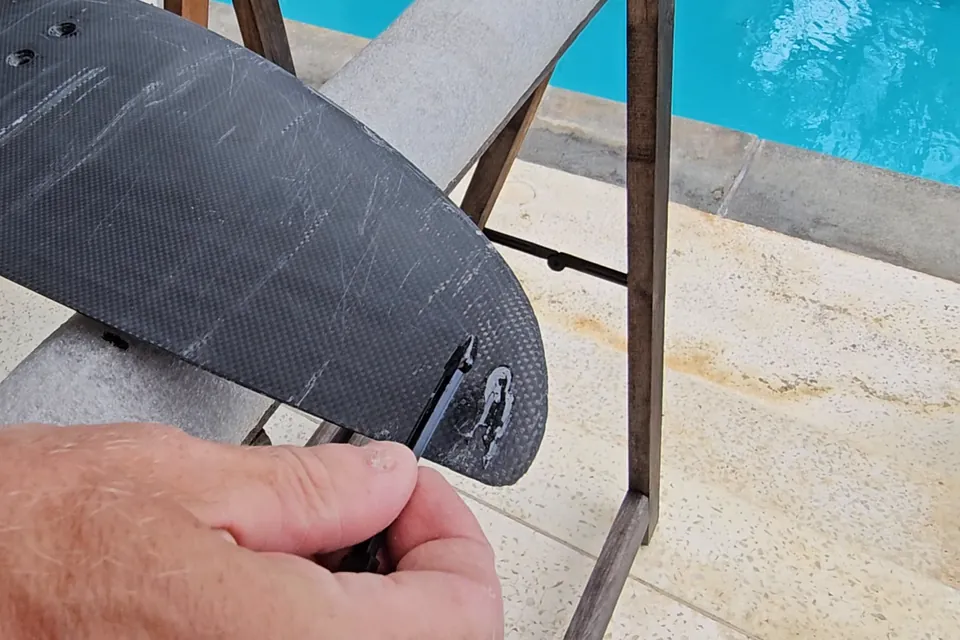
Carbon is strong, but it does not like knocks, especially at the tips and trailing edges. Trailing edges are made very thin on purpose, so they are the most fragile part. Take care: these edges can be sharp.
- Check the leading edge for chips and dents.
- Check the trailing edge for nicks and burrs.
- Check each wing tip for chips or exposed carbon.
- A new whistle on the water often points to an uneven trailing edge.
Mast
- Look along the whole length of the mast, and at both ends where it bolts on.
- If a wing tip hit something, check the mast with extra care. A tip strike puts a big lever force on the mast.
- Some masts are sealed with plugs. If water is getting inside, drain and dry the mast, then check the plugs as your manual describes.
Fuselage and the mast joint
- The fuselage should sit tight and straight on the mast. Any wiggle speeds up wear on the parts and the hardware.
- On aluminium parts, white powder is corrosion. Clean it off and keep an eye on it.
- Do not judge by the outside alone. Aluminium can corrode from the inside, with little to see, and end in a clean break. Rinsing and taking the foil apart after each session is what prevents this.
Bolts and threaded inserts
- Vibration loosens bolts while you ride. Tighten them before each session to the torque in your manual.
- Replace screws that are worn, bent, stripped or rusty. Keep spares in your bag.
- Clean sand out of the threads before you screw anything in. Sand in an insert can damage the thread for good.
- If an insert spins, feels loose or has a damaged thread, stop. Do not force it. In carbon parts, a damaged thread often means the whole part needs replacing.
Cosmetic or red flag?
Usually cosmetic
- Light scratches and white marks your nail does not catch. Most of these do not change how the foil rides.
Fix soon
- Deep scratches and grooves that catch your nail.
- Chipped tips and nicks on the edges.
- Bumps or dents after an impact. The flow over a foil is sensitive to a rough surface. A damaged surface can make the foil stall suddenly and throw you off.
Red flags: stop riding
- Any crack, and above all a crack in the mast. The mast takes the most load.
- Soft spots, skin that moves when you press it, or a dull sound when you tap.
- Water or air squeezing out of a crack or a screw hole when you press nearby.
- Bent, loose or damaged hardware, stripped threads, or a fuselage that wobbles.
One more thing to know. In composites, damage around an impact can reach further than what you see. A small mark after a hard hit deserves a closer look.
When to stop riding
The brands are clear. Cabrinha says that if any part shows wear, stop using it and repair or replace it before you ride again. Sabfoil says never use damaged or broken products. Duotone asks you to check every part for damage after each session and replace what is damaged.
A foil part that fails at speed can hurt you and the people around you. If you are not sure, keep the foil on land until someone has looked at it. A scratch can wait. A crack should not go back in the water.
Not sure what you are looking at?
Send us two photos: a close-up of the damage and one of the whole part. Add the brand and model. We will tell you honestly whether it is a repair job or whether the part should be replaced.
Sources
- ENSIS – How to Repair and Maintain Your Hydro Foil
- SROKA – How to maintain your carbon foil?
- Duotone – SS25 Carbon Mast & Fuselage user manual (PDF)
- Cabrinha – Fusion Foil user manual (PDF)
- Sabfoil – Warning & Safety
- F-ONE – Hydrofoil Carbon Mast user guide (PDF)
- GONG – Aluminium mast foil setup user guide (PDF)
- GONG – Allvator carbon foil user guide (PDF)
- Windance – Wing Foil Maintenance & Corrosion Prevention
- WEST SYSTEM – Fiberglass Boat Repair & Maintenance (PDF)